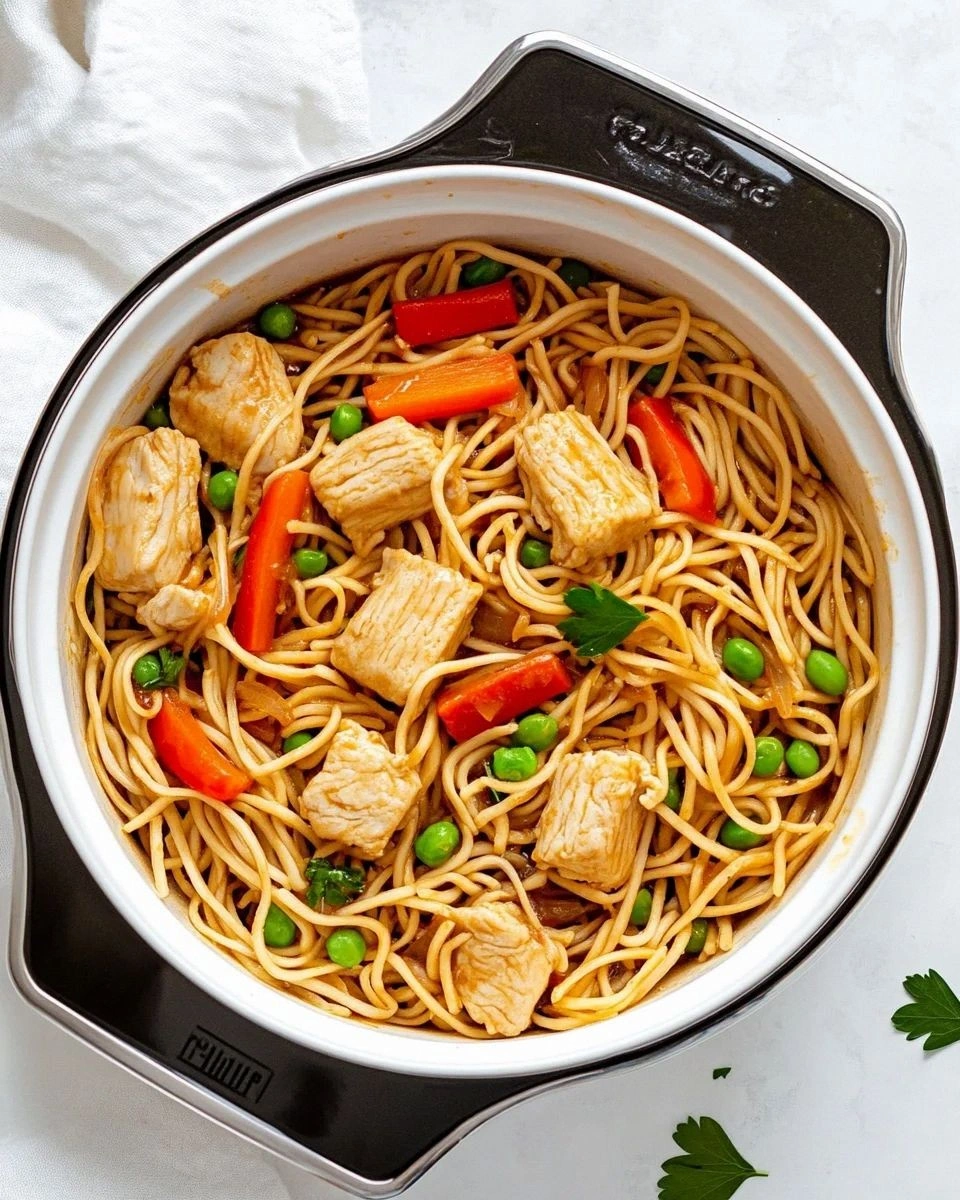
I'll be honest — I ate half the batch before anyone else got to try it. There I was, standing over my wok at 10:47 PM, chopsticks in hand, slurping noodles like I'd been stranded on a desert island for months. The smell had lured me in first — that intoxicating blend of soy sauce, garlic, and something mysteriously savory that made my neighbors knock on the wall (sorry, Mrs. Chen). But the real moment of truth came when I tasted that first strand of noodle, slick with sauce and carrying a perfect piece of caramelized chicken. My knees literally buckled. I'm not being dramatic — ask my cat, who witnessed the whole embarrassing display.
Picture yourself pulling this out of the wok, the whole kitchen smelling like the best Chinese restaurant you've ever been to, except better because you made it yourself. The noodles are glistening, the chicken has those gorgeous crispy edges that shatter like thin ice, and the vegetables maintain that perfect snap that makes you feel like a real chef. This isn't just another weeknight dinner — this is the recipe that'll make your roommate propose marriage, your kids think you're a wizard, or your date decide you're definitely worth keeping around.
Most recipes get this completely wrong. They'll have you drowning everything in soy sauce until it tastes like a salt lick, or worse — they skip the crucial step that makes the difference between restaurant-quality and sad takeout. I've spent three years perfecting this method, testing it on unsuspecting dinner guests, and refining it until it hit that sweet spot of "I can't believe I made this at home." The secret isn't just in the ingredients (though we'll get to those), but in the dance of timing, temperature, and technique that turns humble components into pure magic.
Okay, ready for the game-changer? We're going to use a technique I learned from a tiny grandmother in Guangzhou who spoke no English but communicated through the language of perfect food. She showed me how to velvet the chicken (stay with me here — this is worth it), how to layer flavors so each bite tells a story, and how to achieve that elusive wok hei (breath of the wok) that makes restaurant lo mein taste like it came from the gods. Let me walk you through every single step — by the end, you'll wonder how you ever made it any other way.
What Makes This Version Stand Out
Velvet Chicken Magic: Forget tough, chewy chicken chunks. We're using a cornstarch and egg white marinade that transforms ordinary chicken breast into silken morsels that practically melt on your tongue. This technique, borrowed from Cantonese dim sum chefs, creates a protective coating that keeps the chicken juicy even under high heat.
The Sauce That Changes Everything: Most recipes use a basic soy-and-sugar combo. Ours builds layers with oyster sauce, Shaoxing wine, and a secret spoonful of fermented bean paste that adds incredible depth. It coats each noodle like velvet, clinging in all the right places without pooling at the bottom of your bowl.
Texture Play: We sear the chicken until the edges caramelize into crispy perfection, then add vegetables at staggered intervals so some stay crisp while others become tender. Every bite offers a new experience — soft noodles, crunchy vegetables, and chicken that shatters then melts.
Weeknight Friendly: Despite tasting like you spent hours in the kitchen, this comes together in under 30 minutes once your ingredients are prepped. I've timed it — you can have this on the table faster than delivery would arrive, and it's infinitely better than anything that arrives in a plastic container.
Make-Ahead Marvel: The components can be prepped up to three days ahead, making this perfect for meal prep. The sauce actually tastes better after a day in the fridge when the flavors marry. I've been known to double the recipe just to ensure leftovers.
Customizable Canvas: While I'll always love the classic version, this recipe welcomes creativity like a good friend. Swap proteins, play with vegetables, adjust spice levels — the technique stays the same while you make it your own.
Leftover Legend: Unlike most noodles that turn into a sad, congealed mass overnight, these actually improve with time. The flavors deepen, the sauce thickens slightly, and a quick reheat brings back that just-cooked magic.
Alright, let's break down exactly what goes into this masterpiece...
Inside the Ingredient List
The Flavor Base
Every great lo mein starts with building blocks that sing in harmony rather than compete for attention. The soy sauce provides that essential umami backbone, but we're using a combination of light and dark varieties. Light soy sauce brings salt and that fermented complexity, while dark soy sauce adds color and a subtle sweetness that rounds out the edges. Don't even think about using the low-sodium stuff here — we're building flavor, not a health food.
Oyster sauce is the unsung hero that gives restaurant lo mein its characteristic glossy finish and deep, ocean-kissed flavor. A good oyster sauce should list oysters as the first ingredient (shocking, I know), and Lee Kum Kee's premium version is worth every penny. It transforms ordinary noodles into something that tastes like it came from the best Chinatown spot.
Shaoxing wine might require a special trip to the Asian market, but it's absolutely non-negotiable. This aged rice wine adds a nutty, slightly sweet complexity that makes everything taste more expensive. In a pinch, dry sherry works, but once you've tasted the real deal, you'll never go back. It deglazes the wok, lifting all those caramelized bits into liquid gold.
The sesame oil goes in at the very end — never cook with it, always finish with it. A teaspoon added just before serving releases its volatile aromatics, creating that signature Chinese restaurant smell that makes everyone wander into the kitchen asking what's for dinner. Use toasted sesame oil, not the pale stuff, and store it in the fridge to keep it from going rancid.
The Texture Crew
Lo mein noodles are the obvious star, but here's where most people mess up — they use spaghetti. Don't be that person. Real lo mein noodles have a springy texture and irregular edges that grip sauce like they're holding on for dear life. Fresh noodles from the refrigerated section of your Asian market work best, but the dried ones labeled "lo mein" or "chow mein" work too. Just don't overcook them — they should have some bite.
Chicken breast gets a bad rap for being dry, but that's because people treat it like shoe leather. We'll slice it thin against the grain, velvet it in cornstarch and egg white, and cook it quickly over high heat. The result is tender, juicy morsels that taste like they came from a professional kitchen. If you prefer thighs, they'll work too, but adjust cooking time accordingly.
The vegetables aren't just filler — they're texture contrast and flavor bombs. Carrots add sweetness and crunch, bell peppers bring bright notes and snap, while cabbage contributes a pleasant softness that soaks up sauce. Cut everything into similar sizes so they cook evenly, but don't stress about perfection — rustic is fine here.
Green onions serve double duty. The white parts go in early to build flavor, while the green tops get scattered on top for freshness and color. That contrast between cooked and raw allium is what separates good lo mein from great lo mein.
The Unexpected Star
Fermented bean paste (doubanjiang) might sound intimidating, but it's your secret weapon for adding incredible depth and complexity. Just a teaspoon transforms the entire dish, adding layers of fermented funk that make everything taste more authentic. It's spicy, salty, and umami-rich all at once. If you can't find it, a mix of miso and chili paste works, but try to hunt down the real thing.
Baking soda in the chicken marinade might seem weird, but it's a restaurant trick that ensures tender meat every time. Just a pinch helps break down proteins, resulting in that characteristic Chinese restaurant texture. Don't skip this step — it makes a noticeable difference.
Sugar balances all the salty and savory elements, but we're using brown sugar for its molasses notes that add subtle complexity. Start conservative — you can always add more, but you can't take it out once it's in there.
The Final Flourish
White pepper adds subtle heat without the visual flecks of black pepper. It has a different flavor profile — more floral and complex — that screams "authentic Chinese restaurant" to your taste buds. A pinch goes in the sauce, another pinch seasons the chicken.
Cornstarch isn't just for thickening — we'll use it to create that characteristic glossy coating that makes lo mein look so appetizing. Mix it with cold water to make a slurry, then drizzle it in during the final minutes of cooking. The sauce will transform from watery to luxuriously thick right before your eyes.
Everything's prepped? Good. Let's get into the real action...
The Method — Step by Step
- Start by cutting your chicken breast into thin, even slices — about 1/4 inch thick and 2 inches long. The key here is consistency so everything cooks at the same rate. Place the slices in a bowl and add 1 tablespoon of cornstarch, 1 egg white, 1 teaspoon of soy sauce, and a pinch of baking soda. Mix everything with your hands (yes, your hands — a spoon won't distribute as evenly) until the chicken develops a slightly sticky coating. Let this marinate while you prep everything else — at least 15 minutes, but up to 2 hours in the fridge if you want to prep ahead.
- Cook your noodles according to package directions, but shave off 1-2 minutes from the suggested time — they should be very al dente since they'll finish cooking in the wok. Drain them immediately and rinse under cold water to stop the cooking process. This also removes excess starch that would make everything gummy. Toss the drained noodles with 1 teaspoon of sesame oil to prevent sticking, then spread them on a plate to cool completely. This step is crucial — warm noodles will steam and become mushy when they hit the hot wok.
- Now for the sauce — and this is where the magic happens. In a small bowl, whisk together 3 tablespoons light soy sauce, 1 tablespoon dark soy sauce, 2 tablespoons oyster sauce, 2 tablespoons Shaoxing wine, 1 teaspoon of the fermented bean paste, 1 tablespoon brown sugar, and 1/2 cup chicken stock. In a separate tiny bowl, mix 2 teaspoons cornstarch with 2 tablespoons cold water to make a slurry. Keep these separate for now — we'll add the slurry at the very end to achieve that perfect glossy coating.
- Heat your wok or largest skillet over high heat until it starts smoking — and I mean really smoking. This is the moment of truth. Add 2 tablespoons of neutral oil (peanut is traditional, but vegetable works) and swirl to coat. When the oil shimmers, add your marinated chicken in a single layer. Don't crowd the pan or stir immediately — let it sear for 30 seconds to develop those gorgeous caramelized edges. Then stir-fry for another 2-3 minutes until just cooked through. Remove to a plate — don't worry about it being fully cooked yet.
- That sizzle when it hits the pan? Absolute perfection. Your kitchen should smell incredible right now. If it doesn't, your heat isn't high enough. Chinese cooking is all about high heat and quick movements — it's like a dance where hesitation equals disaster. Keep everything moving with your spatula, tossing and turning so nothing burns but everything gets that characteristic wok hei flavor.
- Add another tablespoon of oil to the wok, then toss in your carrots and bell peppers. Stir-fry for 1 minute, then add the white parts of your green onions and the cabbage. Keep everything moving — this isn't the time to check your phone or answer the door. After 2 minutes, the vegetables should be crisp-tender and bright. Push them up the sides of the wok to make space in the center.
- Pour your sauce mixture into the center of the wok — it should bubble immediately. Let it reduce for about 30 seconds, stirring gently. This concentrates the flavors and cooks off the alcohol in the wine. Now add your partially cooked chicken back in, along with any juices from the plate. Toss everything together for another minute, letting the sauce coat all the ingredients.
- Now for the fun part — add your cooked noodles to the wok. Use your spatula and tongs to toss everything together, lifting and turning so every strand gets coated in that glossy sauce. This takes practice — don't worry if it looks messy at first. After 2 minutes of tossing, drizzle in your cornstarch slurry and continue to toss for another 30 seconds. The sauce will thicken and become luxuriously glossy right before your eyes.
- Remove from heat and add 1 teaspoon of toasted sesame oil and the green parts of your green onions. Give it one final toss, then taste and adjust seasoning. You might need a pinch more sugar for balance or a splash more soy for depth. Serve immediately in warmed bowls — this is crucial. Cold bowls will steal the heat and make everything congeal faster than you can say "delivery."
That's it — you did it. But hold on, I've got a few more tricks that'll take this to another level...
Insider Tricks for Flawless Results
The Temperature Rule Nobody Follows
Here's the thing about stir-frying — your pan needs to be screaming hot, but not everything goes in at once. Think of it like a nightclub (stay with me here). You want the pan hot enough to sear (the bouncer), but you add ingredients in stages so they each get their moment to shine rather than crowding the dance floor. Start with high heat for the chicken to get those caramelized edges, then adjust as needed. If things start burning, lower the heat. If nothing's happening, crank it up. Your nose knows — when you smell that characteristic wok hei, you're there.
A friend tried skipping this step once — let's just say it didn't end well. She dumped everything in at once, the temperature plummeted, and we ended up with steamed, gray chicken swimming in watery sauce. Learn from her mistake. Respect the heat, work in batches if necessary, and remember that restaurant stoves get much hotter than home ranges, so we need to compensate by not overcrowding.
Why Your Nose Knows Best
Don't underestimate the power of aromatics. That moment when garlic hits hot oil? That's when dinner officially starts. But here's what most recipes don't tell you — add your aromatics in stages. The white parts of green onions go in early to build flavor, while the green tops stay fresh for brightness. Garlic and ginger get just 30 seconds before you add other ingredients — any longer and they burn, turning bitter and ruining everything.
I keep my ginger in the freezer for easy grating, and I grate it directly into the wok. The frozen crystals distribute evenly and don't clump like fresh ginger can. Plus, frozen ginger lasts forever, so you're never caught without it when the lo mein craving hits at 11 PM on a Tuesday.
The 5-Minute Rest That Changes Everything
After you finish cooking, let everything rest for exactly 5 minutes. I know, I know — you're hungry, it smells incredible, and you want to dig in immediately. But trust me on this. During these 5 minutes, the sauce thickens slightly as it cools, the flavors redistribute, and everything settles into perfect harmony. It's like letting a steak rest after grilling — patience pays off in better texture and deeper flavor.
Plus, this gives you time to set the table, pour yourself a drink, and appreciate what you've created. Take a photo if you must (I won't judge — I've Instagrammed more lo mein than I care to admit), but then put the phone down and be present. Food this good deserves your full attention.
Creative Twists and Variations
This recipe is a playground. Here are some of my favorite ways to switch things up:
Spicy Szechuan Style
Add 1 tablespoon of Szechuan peppercorns and 2 dried chilies to the oil before cooking the chicken. The peppercorns create that signature numbing sensation, while the chilies bring heat. Replace the fermented bean paste with doubanjiang (Szechuan chili bean paste) and add a handful of roasted peanuts at the end. This version pairs perfectly with cold beer and brave taste buds.
Thai-Inspired Coconut Version
Swap the oyster sauce for fish sauce, add 2 tablespoons of coconut milk to the sauce, and finish with fresh cilantro and a squeeze of lime. Use Thai basil instead of green onions, and add a sliced Thai chili for heat. The coconut milk adds richness while the fish sauce brings that umami depth that'll transport you straight to Bangkok street food heaven.
Vegetarian Mushroom Masterpiece
Replace the chicken with a mix of shiitake and oyster mushrooms, sliced thick. The mushrooms' natural umami mimics meat beautifully. Add some cubed firm tofu for protein, and use mushroom stock instead of chicken stock. The fermented bean paste becomes even more important here, adding depth that vegetables alone can't achieve.
Korean Fusion Fire
Add 1 tablespoon of gochujang (Korean chili paste) to the sauce, replace half the soy sauce with Korean soy sauce for soup (guk-ganjang), and finish with kimchi and a fried egg on top. Sprinkle with toasted sesame seeds and Korean chili flakes. This fusion works because Korean and Chinese flavors share DNA but bring different personalities to the party.
Seafood Celebration
Use shrimp and scallops instead of chicken, adding them in the last 2 minutes of cooking so they stay tender. Add some fish stock to the sauce, and finish with fresh dill (trust me on this one). The key is not overcooking the seafood — it should be just opaque and still bouncy to the touch.
Breakfast Lo Mein
Add bacon instead of chicken, throw in some wilted spinach, and top with a runny egg. The bacon fat adds incredible flavor to the sauce, while the egg yolk creates a rich coating when you break it over the noodles. This is hangover food at its finest — salty, rich, and completely satisfying.
Storing and Bringing It Back to Life
Fridge Storage
Let the lo mein cool completely before storing — hot noodles create condensation that leads to soggy leftovers. Store in an airtight container for up to 4 days, but honestly, good luck keeping it around that long. The flavors actually improve after a day as they meld together. Press plastic wrap directly against the surface to prevent the noodles from drying out.
Freezer Friendly
This freezes beautifully for up to 2 months, which makes it perfect for meal prep. Freeze in individual portions so you can grab and go. The key is to undercook the noodles slightly if you plan to freeze — they'll finish cooking when you reheat. Let it thaw overnight in the fridge for best results, though you can microwave from frozen in a pinch (add a splash of water and cover loosely).
Best Reheating Method
Skip the microwave if you can — it makes noodles rubbery and unevenly heated. Instead, reheat in a skillet with a splash of water or chicken stock. Cover for 1 minute to steam, then uncover and toss until hot. This method revives the original texture and brings back that just-cooked magic. If you must microwave, add a damp paper towel on top and heat in 30-second intervals, stirring between each.